

ISO 9001 for Manufacturing Companies: Requirements, Evidence and Templates
Short answer: for a manufacturer, ISO 9001 is about showing that what you make is controlled from purchase order to dispatch: approved suppliers, incoming inspection, work instructions and travelers, calibrated gauges, release checks, traceability and a working NCR and corrective action loop. The 2026 edition adds weight to quality culture, separates risks from opportunities, adds follow-up to planned changes and keeps climate change in context. Templates cover the paperwork so your team can focus on the process.
See the Complete QMS Kit for first certification, or the Transition Starter Bundle if you already hold ISO 9001:2015. Jump to templates and training by role.
What an auditor looks for in a factory
| Area (ISO 9001:2026) | Typical manufacturing evidence |
|---|---|
| External providers (8.4) | Approved supplier list with selection and performance scoring, purchase order requirements, incoming inspection records. |
| Production control (8.5.1) | Work instructions, job travelers or routers, setup and first-off checks, in-process inspection. |
| Identification and traceability (8.5.2) | Lot or batch numbers, inspection status labels, the ability to trace a part back to material and process records where you need to. |
| Monitoring and measuring resources (7.1.5) | Calibration register, calibration certificates, and what you do when a gauge is found out of tolerance. |
| Infrastructure (7.1.3) | Equipment register and preventive maintenance schedule with completed records. |
| Release (8.6) | Final inspection records showing who released the product and against what criteria. |
| Nonconforming outputs (8.7, 10.2) | NCR log, quarantine and disposition (rework, scrap, use as is with authority), and corrective actions for repeat issues. |
What the 2026 edition changes for manufacturers
- Risks and opportunities (6.1.2, 6.1.3). Supply disruption, single-source parts and key-machine failure as risks; automation, new materials or new markets as opportunities. Our register includes manufacturing examples.
- Planning of changes (6.3). Moving a line, adding a shift or introducing a new ERP system needs planning and follow-up.
- Organizational knowledge (7.1.6). Setup know-how that lives in one experienced machinist's head is a classic gap. A knowledge register makes it visible.
- Climate change in context (4.1). Energy costs, extreme heat in the plant and supply disruption are the usual reasons it becomes relevant.
- Quality culture (5.1.1, 7.3). Operators should feel able to stop the line or raise an NCR without blame.
Which templates to start with
| Your situation | Start with |
|---|---|
| Not yet certified | Complete QMS Documentation Kit ($349): 20 procedures including production, release, calibration and purchasing, plus forms such as the job traveler, incoming inspection record, calibration register, preventive maintenance schedule, approved supplier list and NCR log. |
| Certified to ISO 9001:2015 | Transition Starter Bundle ($99), then the Risk and Opportunity Register and Organizational Knowledge Register. |
| Running the whole transition in-house | Transition Toolkit ($199): all 11 transition tools. |
Templates and training by role
A factory usually needs the documents plus at least one person who knows how to run and audit the system. Match each role to what it needs:
| Role | Templates | Training |
|---|---|---|
| Quality manager setting up the system | Complete QMS Kit, $349 | Lead Implementer course, $349 |
| Quality lead moving a 2015 certificate to 2026 | Transition Toolkit, $199 | Transition Masterclass, $149 |
| Internal auditors and quality engineers | Internal Audit Checklist, $59 | Internal Auditor course, $249 (its mock audit is set in a contract machining company) |
| Production supervisors and team leaders | Awareness Training Kit for your briefings, $69 | Foundations course, $79 |
| Operators on every shift | Awareness Training Kit ($69): one 45-minute session or a one-page toolbox talk for unlimited staff, with an attendance record. | |
Training several people? The Team Training Pack enrols five learners from $299. For one person who needs every course, the Complete Training Track covers all four for $599.
Courses are online and self-paced, with lessons narrated by an AI voice from the instructor's scripts. Each ends with a Certificate of Completion from ISO Cloud Consulting. It is not an accredited qualification. Courses carry a 30-day money-back guarantee before the final exam.
Automotive, aerospace or medical customers?
ISO 9001 is the base. Automotive suppliers often need IATF 16949, aerospace suppliers AS9100, and medical device manufacturers ISO 13485. Each adds sector requirements on top of a quality management system like the one these templates build. If you make medical devices, see our ISO 13485 Complete QMS Kit instead.
Want an expert to check your system?
We run remote ISO 9001 gap assessments from $1,250. Consulting does not guarantee certification.
This page describes requirements in our own words and does not reproduce ISO 9001. Check requirements against your own licensed copy of the standard.
Online course
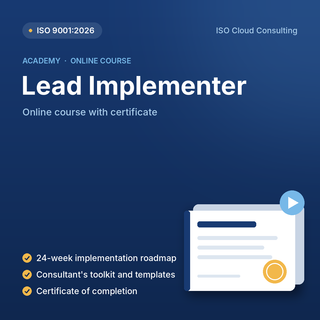
ISO 9001:2026 Lead Implementer Course (Online, Certificate of Completion)
Learn this topic properly: short lessons, worksheets with model answers, a 100% pass mark on every lesson quiz and a certificate of completion. Unlimited access for $349.
Templates that do this job
Editable Word and Excel files. Instant download. Licensed for one organization.


Frequently asked questions
What documents does a manufacturer need for ISO 9001?
The standard requires certain records, such as calibration evidence, competence, release, nonconformities and corrective actions, and leaves the rest to you. Most manufacturers keep a supplier list, travelers or routers, inspection records, a calibration register and an NCR log.
Is ISO 9001 enough for automotive or aerospace customers?
Often not on its own. Automotive customers usually require IATF 16949 and aerospace customers AS9100, which add sector requirements to an ISO 9001-based system.
Do the templates include a job traveler?
Yes. The Complete QMS Kit includes a job traveler form along with incoming inspection, calibration, maintenance and NCR records.
How long does it take a small manufacturer to get certified?
With templates and one person leading part-time, many small manufacturers are ready in about six months. The kit includes a 24-week roadmap.
Can we use our ERP instead of the forms?
Yes. If your ERP already records inspection, traceability or NCRs, use it and delete the matching forms. ISO 9001 cares about the evidence, not the tool.
Want to learn it properly?
Self-paced ISO 9001:2026 and ISO 13485 courses with unlimited access, worksheets with model answers and a certificate of completion. From US$79.