

ISO 9001 for Logistics, Warehousing and Transport Companies
Short answer: for logistics, warehousing and transport companies, ISO 9001 is about protecting your customers' goods and promises: controlled receipt and storage, accurate picking, preservation during handling and transport, traceability, subcontracted haulier control and measurable service levels. Customer property (8.5.3) and preservation (8.5.4) carry more weight here than in most sectors. The 2026 edition adds weight to quality culture, separates risks from opportunities and keeps climate change as a context consideration.
See the Complete QMS Kit, or the Transition Starter Bundle if you already hold ISO 9001:2015. Jump to templates and training by role.
What an auditor looks for in logistics
| Area (ISO 9001:2026) | Typical logistics evidence |
|---|---|
| Customer property (8.5.3) | Goods held for customers identified and protected; damage, loss or discrepancies reported to the customer and recorded. |
| Preservation (8.5.4) | Handling, storage, packaging and temperature control rules; stock rotation; protection in transit. |
| Identification and traceability (8.5.2) | Warehouse management system records, location control, consignment and proof-of-delivery records. |
| External providers (8.4) | Subcontracted hauliers, couriers and storage sites approved and monitored. |
| Infrastructure and monitoring resources (7.1.3, 7.1.5) | Vehicle and forklift maintenance; calibration of scales and temperature loggers. |
| Performance (9.1) | On-time delivery, order accuracy, damage rate and complaint trends. |
| Nonconforming outputs (8.7, 10.2) | Mis-picks, damage and late deliveries logged, with corrective action on repeat causes. |
What the 2026 edition changes for logistics
- Climate change in context (4.1). Weather disruption to routes, heat affecting stored goods and fuel costs are common reasons it is relevant.
- Risks and opportunities (6.1.2, 6.1.3). Driver shortages, single-site dependency and IT outages as risks; new contracts, automation and route optimization as opportunities.
- Planning of changes (6.3). A new WMS, a new site or a major new customer onboarding are QMS changes that need planning and follow-up.
- Quality culture (5.1.1, 7.3). Staff who report damage rather than hide it.
Which templates to start with
| Your situation | Start with |
|---|---|
| Not yet certified | Complete QMS Documentation Kit ($349): service provision, purchasing, calibration and nonconformity procedures, plus forms including a customer property register, equipment register, preventive maintenance schedule, approved supplier list, complaint log and KPI dashboard. |
| Certified to ISO 9001:2015 | Transition Starter Bundle ($99), then the Risk and Opportunity Register and Context and Climate Pack. |
| Running the full transition | Transition Toolkit ($199). |
Design and development usually does not apply to warehousing and haulage. The kit's roadmap shows how to justify it as not applicable and which documents to remove.
Templates and training by role
A logistics business usually needs the documents plus at least one person who knows how to run and audit the system. Match each role to what it needs:
| Role | Templates | Training |
|---|---|---|
| Operations or quality manager setting up the system | Complete QMS Kit, $349 | Lead Implementer course, $349 |
| Quality lead moving a 2015 certificate to 2026 | Transition Toolkit, $199 | Transition Masterclass, $149 |
| Internal auditors | Internal Audit Checklist, $59 | Internal Auditor course, $249 |
| Shift and depot supervisors | Risk and Opportunity Register, $49 | Foundations course, $79 |
| Warehouse staff and drivers | Awareness Training Kit ($69): one 45-minute session or a one-page toolbox talk for unlimited staff, with an attendance record. | |
Training several people? The Team Training Pack enrols five learners from $299. For one person who needs every course, the Complete Training Track covers all four for $599.
Courses are online and self-paced, with lessons narrated by an AI voice from the instructor's scripts. Each ends with a Certificate of Completion from ISO Cloud Consulting. It is not an accredited qualification. Courses carry a 30-day money-back guarantee before the final exam.
Want an expert to check your system?
We run remote ISO 9001 gap assessments from $1,250. Consulting does not guarantee certification.
This page describes requirements in our own words and does not reproduce ISO 9001. Check requirements against your own licensed copy of the standard.
Online course
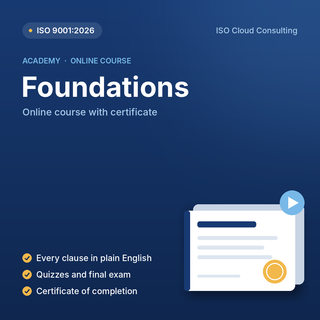
ISO 9001:2026 Foundations Course (Online, Self-Paced, Certificate of Completion)
Learn this topic properly: short lessons, worksheets with model answers, a 100% pass mark on every lesson quiz and a certificate of completion. Unlimited access for $79.
Templates that do this job
Editable Word and Excel files. Instant download. Licensed for one organization.


Frequently asked questions
Does ISO 9001 apply to a warehouse or transport company?
Yes. ISO 9001 applies to any organization that provides products or services. For logistics, the service is receiving, storing, handling and delivering goods to an agreed standard.
Can we exclude design and development?
Usually, if you do not design services or products for customers. Record the justification in your scope.
How do we control subcontracted hauliers?
Set selection criteria, keep an approved list, define your requirements in writing and monitor delivery performance and damage. The kit's approved supplier list includes scoring.
Which KPIs do auditors expect?
ISO 9001 does not set them. Most logistics companies track on-time delivery, order accuracy, damage rate and complaints, with targets in their quality objectives.
Do temperature loggers need calibration?
If you use them to show goods were kept within agreed conditions, yes. They are monitoring resources under 7.1.5 and need calibration or verification records.
Want to learn it properly?
Self-paced ISO 9001:2026 and ISO 13485 courses with unlimited access, worksheets with model answers and a certificate of completion. From US$79.