

What ISO 13485 Clause 4.1 Really Requires
Clause 4.1 is not just “have a QMS.” It requires your organization to document the quality management system, define the regulatory role you operate under, identify the QMS processes you need, determine how those processes interact, apply risk-based controls, monitor process performance, maintain records, control changes, manage outsourced processes, and validate software used in the QMS.
In practice, auditors look for far more than a quality manual. They want to see how your system actually functions: who owns each process, what the inputs and outputs are, how risks are controlled, what evidence proves the process is working, and how you stay in control when suppliers, software or internal workflows change.
A weak Clause 4.1 setup usually creates downstream failures in document control, training, supplier management, CAPA, management review, software validation and audit defence.
The 6 things auditors expect to see under Clause 4.1
-
Documented QMS and defined role
Your quality management system must be established, documented, implemented, maintained, and aligned to your regulatory role, whether you act as manufacturer, distributor, importer, or another regulated party.
-
Defined processes and interactions
You need to identify the QMS processes that apply to your business and show how they connect. A process map with owners, inputs, outputs, and handoffs is one of the clearest ways to do this.
-
Risk-based process control
The standard expects a risk-based approach to controlling appropriate QMS processes. Process risk is not optional background thinking. It must shape how you control the system.
-
Criteria, resources, monitoring, records
Each process needs defined criteria and methods, adequate resources and information, monitoring and analysis, and records that prove it works and stays compliant.
-
Outsourced process oversight
If an external party affects product conformity, you still own the result. Outsourced processes must be monitored and controlled, and written quality agreements are expected.
-
QMS software validation
Software used in the QMS must be validated before first use and after relevant changes, using an approach proportionate to risk.
Why companies fail this clause in real life
Most nonconformities around Clause 4.1 are not caused by missing paperwork alone. They happen because the system is disconnected from the business.
Common failures include:
- a process map that does not match how work is actually done
- no clear ownership of QMS processes
- outsourced manufacturing or critical suppliers with weak oversight
- SharePoint, Excel, or eQMS tools in use with no software validation record
- process KPIs not defined or not reviewed
- risk management treated as separate from the QMS instead of integrated into it
- changes made to processes without impact assessment
- records existing, but not proving process effectiveness
A gap assessment against Clause 4.1 is the quickest way to find which of these apply to you before an auditor does.
Clause 4.1 implementation roadmap
The practical path most companies need: define the system, connect the processes, control outsourced activities, and validate the software that supports the QMS. If one of those pieces is weak, the system usually looks complete but behaves badly under audit.
Define your regulatory role and QMS scope
Be explicit about whether you operate as a manufacturer, virtual manufacturer, distributor, importer, design-only organization, or a mixed model. Your QMS has to reflect that role, not a generic template structure.
Map the QMS processes and their interactions
Build a process map that shows ownership, inputs, outputs, records, KPIs, and links between management review, document control, training, supplier control, risk management, CAPA, internal audit, and product realization.
Control outsourced processes properly
If external parties affect conformity, you still own the outcome. Define oversight methods, approval criteria, monitoring expectations, escalation rules, and written quality agreements where required.
Validate QMS software and keep change under control
Spreadsheet logs, document control platforms, training systems, complaint systems, CAPA tools, SharePoint workflows, and eQMS tools all need risk-based software validation where they are used within the QMS. Changes must be assessed before they weaken control.
Audit-ready evidence checklist
- Defined QMS scope and organizational role
- Process map showing sequence and interaction
- Process owners, criteria, methods, and KPIs
- Records showing process monitoring and effectiveness
- Outsourced process controls and quality agreements
- Risk-based justification for process controls
- Software validation records for QMS tools
- Change impact assessment records
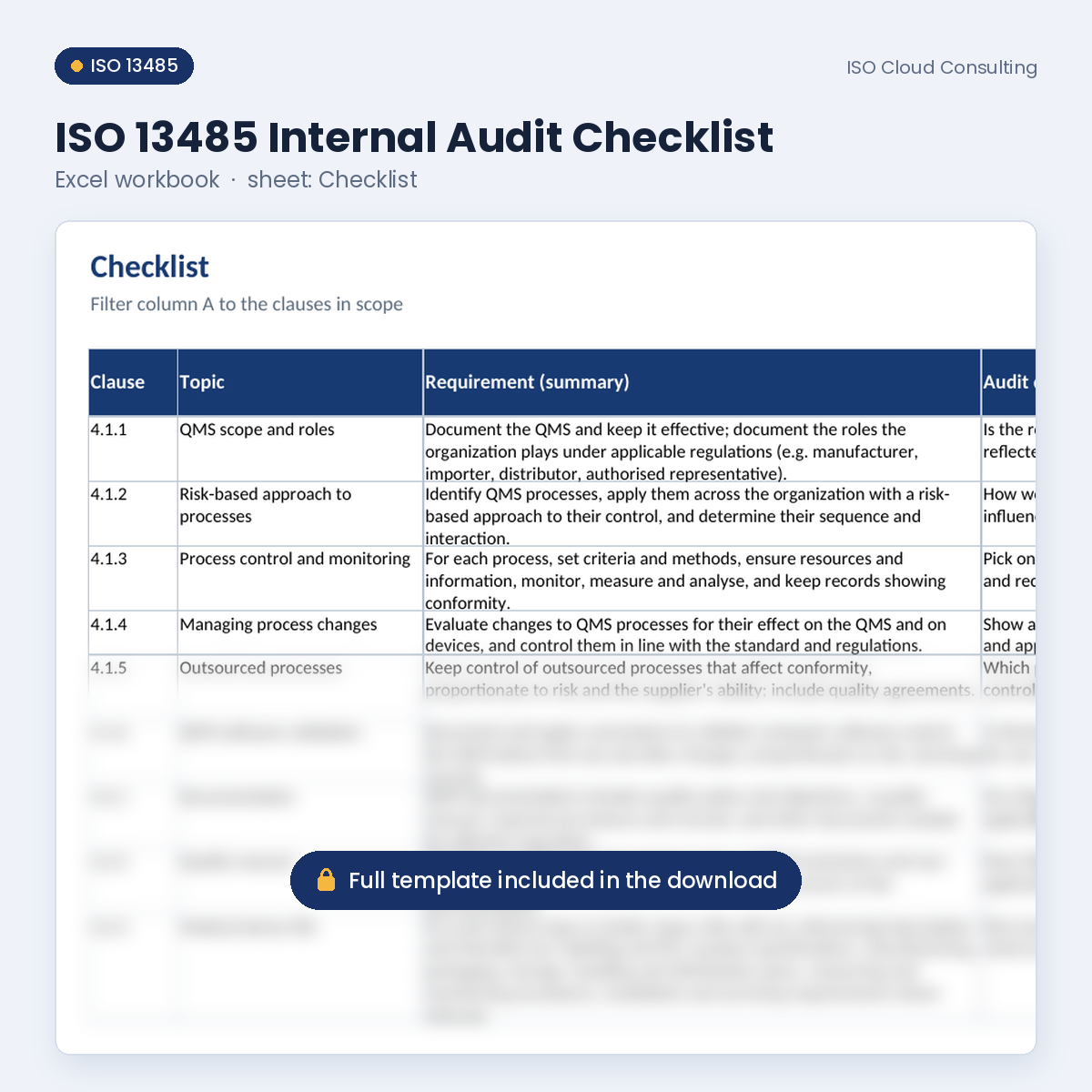
The ISO 13485 Starter Kit gives you the quality manual, core procedures and registers that Clause 4 depends on.
View the Starter KitFix the document architecture behind the QMS before audit drift turns into repeated findings.
View the Document Control KitIf your QMS depends on spreadsheets, SharePoint, or software workflows, this closes one of the most common Clause 4.1.6 gaps.
View the Software Validation KitWhat good Clause 4.1 implementation looks like
A good Clause 4.1 system is visible. You can see the process architecture, the process owners, the metrics, the records, the supplier controls, the software validation logic, and the change controls without having to reverse-engineer the business.
A strong setup usually includes:
- a simple QMS process map that matches the real company workflow
- defined process owners and review responsibilities
- links between QMS processes and risk management
- evidence that outsourced activities are actively controlled
- process KPIs reviewed through management review and internal audit
- documented justification when tools, workflows, or responsibilities change
- software validation proportional to the risk of the system being used
Templates give you the structure. Making it match how your company actually works is the part most teams underestimate, and it is where a short review by someone who has implemented ISO 13485 saves the most time.
Outsourced processes and software validation: where most Clause 4.1 findings come from
Outsourced process control and QMS software validation are the two areas where Clause 4.1 findings most often appear.
If you outsource manufacturing, sterilization, warehousing, document handling, training administration, complaint intake, or any other activity that can affect product conformity, Clause 4.1 expects real oversight. The responsibility does not disappear because the work is external.
If you rely on software inside the QMS, Clause 4.1.6 applies directly. That includes systems used for document control, records, training, logs, approvals, CAPA tracking, supplier management, risk tracking, calibration records, and other QMS workflows. The validation effort should be proportionate to risk, but the expectation is still there.
Who this guide is for
This guide is written for:
- startup manufacturers building their first real QMS
- virtual manufacturers needing stronger outsourced process control
- distributors and importers needing a role-appropriate system
- quality managers cleaning up inherited, disconnected QMS structures
- founders and CEOs moving from “owning templates” to “controlling the system”
- teams facing certification, surveillance, supplier, or remediation audits
Not sure which kit fits your role? The comparison page sets out what each option includes, what it leaves out, and who it suits.
Recommended kits for Clause 4.1
-
ISO 13485 Starter Kit
View ProductBest fit if you need the core QMS foundation (quality manual, document control, CAPA, internal audit, management review), not just isolated fixes.
-
Document Control and Records Kit
View ProductBest fit if your QMS structure exists but document control, revision control, record retention, and master list discipline are weak.
-
Software Validation Kit
View ProductBest fit if your audit gap sits around Excel logs, SharePoint workflows, eQMS tools, or other software used to support the QMS.
FAQ — ISO 13485 Clause 4.1
What does ISO 13485 Clause 4.1 require?
Clause 4.1 requires an organization to establish, document, implement, and maintain a quality management system, define its regulatory role, determine the QMS processes it needs, control those processes using a risk-based approach, maintain records, control changes, oversee outsourced processes, and validate software used in the QMS.
Is Clause 4.1 only about having procedures?
No. Procedures matter, but Clause 4.1 is broader. It is about whether the QMS operates as a controlled system with defined processes, ownership, monitoring, records, change control, and external oversight where needed.
Do I need a process map for ISO 13485 Clause 4.1?
The standard does not force a specific format, but most companies need a process map or equivalent process interaction model to show sequence, interaction, and ownership clearly during implementation and audit.
Does outsourced manufacturing fall under Clause 4.1?
Yes. If an outsourced process affects conformity to requirements, the organization still retains responsibility and must monitor and control that process appropriately.
Do I need software validation for Excel or SharePoint?
If those tools are used as part of the QMS and affect compliance or product conformity, they should be validated using an approach proportionate to risk. Many companies miss this.
What records support Clause 4.1 compliance?
Typical evidence includes process maps, ownership records, KPI or process monitoring records, internal audit outputs, management review inputs, supplier oversight records, quality agreements, change assessments, and software validation records.
How does Clause 4.1 link to document control and records?
Clause 4.1 creates the system framework. Document control and records then sit underneath that framework as essential controls that prove the system is functioning and compliant.
Can a startup implement Clause 4.1 without a large eQMS?
Yes, but the system still needs to be coherent, controlled, and validated where software is used. A smaller business can keep it lean, but not vague.

ISO 13485 Starter Kit


Do not treat Clause 4.1 like a filler clause
It is the operating logic of the QMS. Get this right and document control, training, supplier control, software validation, internal audit, and management review become much easier to defend. Get it wrong and problems spread everywhere.
For companies building or repairing the main QMS architecture.
Compare the bundlesFor document structure, controlled records, training systems, and operational discipline.
Browse collectionFor validating spreadsheets, SharePoint and other software used inside the QMS.
View the kit