

What ISO 13485 Clause 4.2 really requires
Clause 4.2 is not just “have procedures.” Your QMS documentation must include a documented quality policy and quality objectives, a quality manual, the documented procedures and records required by the standard, other documents needed for effective planning and control, and documentation required by applicable regulations. Clause 4.2 also requires one or more medical device files, document control and record control.
Auditors are not only asking whether a procedure exists. They ask whether the right documents exist, whether the current revision is controlled, whether obsolete documents are prevented from unintended use, whether records are secure and retrievable, whether confidential health information is protected, and whether the documentation structure makes sense for the type of company and devices you manage.
The most common findings here are messy document systems, generic quality manuals, incomplete medical device files and records that cannot be retrieved quickly.
The 5 documentation pillars inside Clause 4.2
-
QMS documentation
Your system must include the documented policies, objectives, procedures, records, and other documents needed to operate and control the QMS effectively.
-
Quality manual
The quality manual must define scope, exclusions or non-applications, reference the QMS procedures, and describe how the QMS processes interact.
-
Medical device file
For each device type or family, you need one or more files containing or referencing the documents that demonstrate conformity and regulatory compliance.
-
Control of documents
You must control approval, revision status, updates, point-of-use availability, legibility, external documents, obsolete documents, and retention of old versions.
-
Control of records
You must control identification, storage, security, integrity, retrieval, retention time, disposition, change traceability, and protection of confidential health information.
Why companies get hit on Clause 4.2
Most companies do not fail Clause 4.2 because they have no documents. They fail because they have too many uncontrolled ones.
Common problems include:
- people using outdated forms from shared folders
- no clear master list or document index
- SOPs approved once and never reviewed again
- training records against the wrong revision
- external standards and regulatory references not controlled
- medical device files missing core content
- obsolete documents left in circulation
- records saved, but not easily retrievable during audit
- no defined retention logic for records and obsolete documents
- confidential information handled casually inside QMS records
If several of these sound familiar, start with a gap assessment so you fix the problems that carry the most audit risk first.
Clause 4.2 implementation roadmap
A clean document system is not about writing more SOPs. It is about a documentation architecture people can use, auditors can follow, and your business can maintain.
Define the documentation hierarchy
Set the structure first: quality manual, procedures, forms, work instructions, records, logs, templates, and external documents. If the hierarchy is unclear, document control becomes reactive and messy.
Build document control rules people can actually follow
Approval, review, revision history, change control, distribution, access, archival, and obsolete document control need to be simple enough for real teams to use consistently.
Separate documents from records properly
Procedures tell people what to do. Records prove what happened. Mixing the two creates audit friction, training errors, and retrieval problems.
Establish the medical device file logic
For each device type or family, your file structure should make intended use, specifications, labelling, manufacturing references, monitoring references, installation needs, and servicing references easy to locate.
Lock down retention and retrieval
If records cannot be retrieved quickly, trusted, or tied to the right revision and period, the system looks weak in front of auditors even when the work was done properly.
Audit-ready evidence checklist
- Quality policy and quality objectives
- Quality manual with scope and process interaction
- Controlled document procedure
- Controlled record procedure
- Master document list or equivalent index
- Revision history and approval evidence
- External document control method
- Obsolete document retention logic
- Medical device file structure for each device type or family
- Record retention and retrieval rules
- Protection of confidential health information
Best fit if your procedures, forms, records, logs and revision controls are not operating as one controlled system.
View the Document Control KitUse this if your gap also includes labelling, intended use documentation or file completeness for specific devices.
View the Medical Device File KitFix the wider system if document control is only one part of a bigger QMS weakness.
View the Starter KitClause 4.2.2: Your quality manual should explain the system, not decorate it
A weak quality manual is one of the fastest ways to make a QMS look generic. Under Clause 4.2.2, the quality manual must define the scope of the QMS, explain any exclusions or non-applications, reference the documented procedures, and describe the interaction between QMS processes. It also needs to outline the structure of the documentation used in the QMS.
Your quality manual should work as a system map, not a marketing summary. It should help a regulator, auditor or internal team member understand how the system is structured and where evidence lives.
Clause 4.2.3: The medical device file is where documentation gets product-specific
This is where many companies underestimate the clause. Clause 4.2.3 requires one or more files for each medical device type or family containing or referencing documents that show conformity to ISO 13485 and applicable regulatory requirements. The file content includes at least a general device description and intended use, labelling, product specifications, manufacturing or handling references, measuring and monitoring references, and, where relevant, installation and servicing references.
So Clause 4.2 is not only about generic QMS documents. It also reaches into product-specific documentation and how that evidence is structured.
Clauses 4.2.4 and 4.2.5: Document control and record control are not the same thing
A document is controlled so people know what they should use. A record is controlled so you can prove what happened.
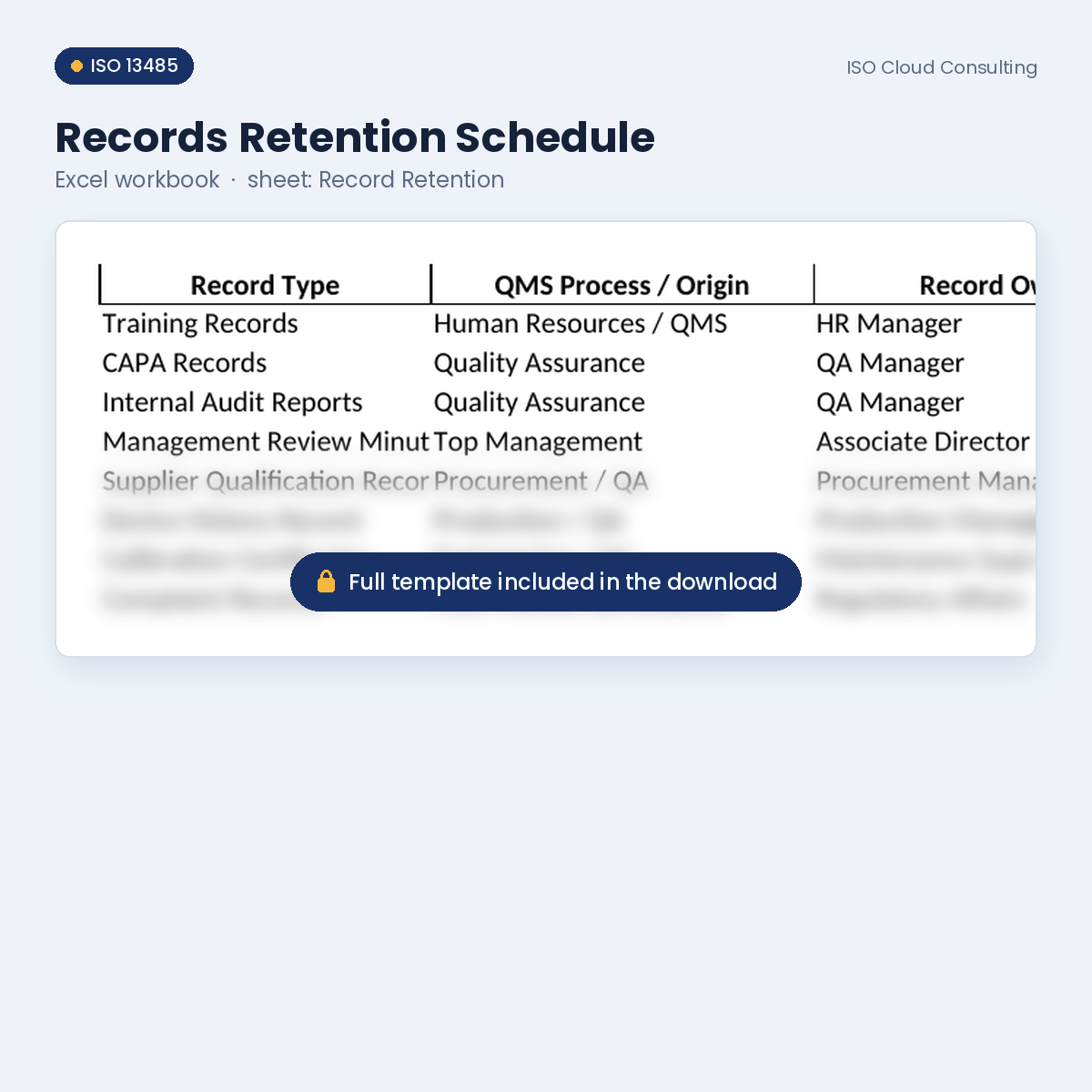
Clause 4.2.4 focuses on document approval, review, updating, revision status, point-of-use availability, legibility, external documents, prevention of deterioration or loss, and prevention of unintended use of obsolete documents. Clause 4.2.5 focuses on identification, storage, security, integrity, retrieval, retention time, disposition, change traceability, and protection of confidential health information inside records. It also sets the baseline retention expectation: at least the lifetime of the device as defined by the organization, or as regulations require, but not less than two years from release.
Getting this distinction right clears up a lot of long-standing confusion in document systems.
Best-fit kits for Clause 4.2
-
Document Control and Records Kit
View ProductBest fit if your issue is revision control, document hierarchy, approval flow, master list discipline, obsolete document control, and record structure.
-
Medical Device File and Labelling Kit
View ProductBest fit if your documentation gap includes device-level file structure, intended use, labelling, and product-specific evidence.
-
ISO 13485 Starter Kit
View ProductBest fit if Clause 4.2 problems are part of a broader QMS architecture issue.
Clause 4.2 FAQ
What does ISO 13485 Clause 4.2 require?
Clause 4.2 requires documented QMS information including quality policy and objectives, a quality manual, required procedures and records, other necessary QMS documents, regulatory documentation, medical device files, document control, and record control.
Do I still need a quality manual under ISO 13485?
Yes. Clause 4.2.2 explicitly requires a quality manual, including QMS scope, justified exclusions or non-applications, references to QMS procedures, and a description of process interaction.
What is a medical device file under ISO 13485?
It is a device-type or device-family file containing or referencing documents that demonstrate conformity to ISO 13485 and applicable regulatory requirements. It is not just one product datasheet.
Is a master document list required by the standard?
The standard does not force that exact title, but most companies need a master document list or equivalent controlled index to manage revision status, document location, approval, and availability effectively.
What is the difference between a document and a record?
A document tells people what to do or what applies. A record proves what was done, what happened, or what decision was made. Both are controlled, but in different ways.
Do external standards and regulations need document control?
Yes. Clause 4.2.4 requires external-origin documents necessary for planning and operation of the QMS to be identified and their distribution controlled.
How long do I need to keep obsolete documents?
You must keep at least one copy of obsolete documents for a defined period long enough to ensure documents tied to manufactured and tested devices remain available for at least the lifetime of the device, and not less than the retention period of resulting records unless regulations require more.
How long do I need to keep records under ISO 13485?
Records must be retained for at least the lifetime of the medical device as defined by the organization, or as required by regulation, but not less than two years from product release.
Does Clause 4.2 include protection of confidential health information?
Yes. Clause 4.2.5 specifically requires methods to protect confidential health information contained in records in accordance with applicable regulatory requirements.

Document control SOP, master list and record templates
ISO 13485 Document Control & Records Kit


Clause 4.2 is where document chaos gets exposed
Get this right and your quality manual, procedures, forms, records, training evidence, device files and audit trails start working together. Get it wrong and every audit feels harder than it should.
For document hierarchy, revision control, training systems, logs, forms and operational discipline.
Browse collectionFor product-specific file structure, labelling controls and documentation linked to device conformity.
View the kitMaster document list, gap check and other free tools to start cleaning up the system.
Browse collection